It Was Almost Done for Six Years
The Beetle sat on four jackstands long enough that I stopped seeing the jackstands.
That is the part nobody warns you about. A car on stands is an emergency for about three weeks. After that it becomes furniture. You walk past it to get to the leaf blower. You set a box of trim on the roof because the roof is a flat surface at a useful height. Somewhere in there it quits being a car you are fixing and turns into a shape in the garage.
Mine was a 1961, bought with rust in the front apron and the lower front fenders. Cosmetic rust, not structural. I wanted to make a “rat rod.” Pans were solid. Heater channels were solid, which on an old Beetle is the whole ballgame. That car did not need saving. It needed metalwork on the front third and then it needed to be driven.
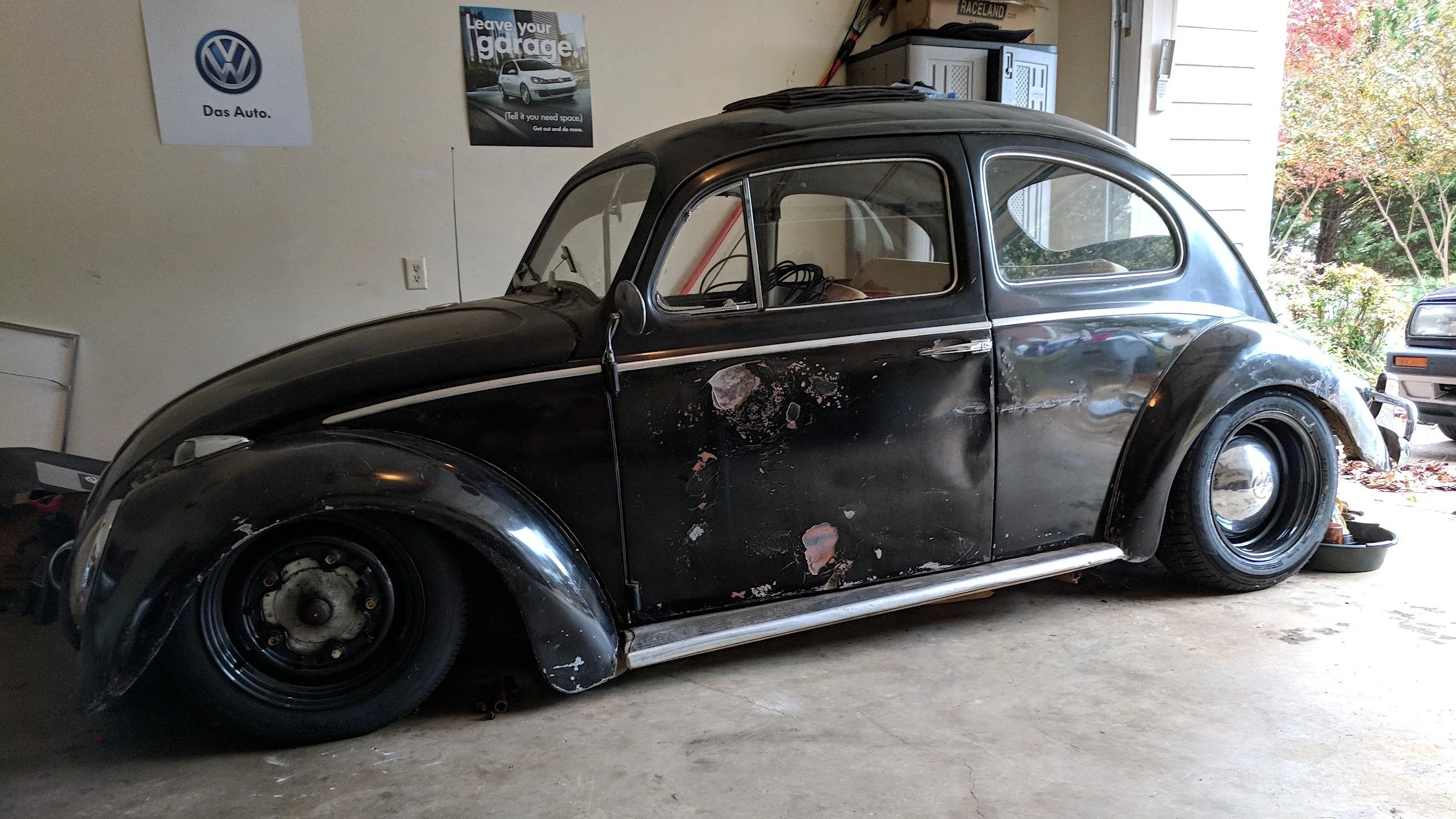
Back sitting on its wheels, drain pan still under it. This was the good stage.
I could have paid a shop. Instead I signed up for a night welding class at the community college, because I had wanted to learn to weld for years and here was a reason with wheels on it.
The class was one of the better decisions I have made. I still use what I learned in it. The Beetle is a different story.
The spiral is made of reasonable decisions
Once you have the front clip apart, everything else is right there.
The apron came out. Patches got fabricated and fit. Then the front beam was accessible, so air suspension went in, because when else are you going to do it. Then the air setup meant rethinking the wheels. Then a few other things, each of which made perfect sense on the Tuesday night I decided to do it.
Not one of those choices was stupid in isolation. Stacked, they added up to a sentence with no release date.
Here is the thing I did not see for six years: the car was improving and my access to it was getting worse, and those two lines were moving in opposite directions the entire time. I never once sat down and really thought about it. I only ever looked at the car. And the car looked better every few months, so I felt like I was slowly winning.
The money is not what holds you
Everybody reaches for the sunk cost fallacy here, and everybody is about half right.
Daniel Kahneman won a Nobel Prize for work on how people actually make decisions, and when Morgan Housel asked him about persistence at a dinner in 2017, he said he keeps none. His line was "When I work I have no sunk costs. I like changing my mind." He went on to say he can walk away from an idea he has spent a year on the moment a better one shows up, and that too much persistence is a real liability.
A year of work. Gone, on purpose, by a man who studied this for a living.
The money is the easier part to walk away from anyway. Money is abstract by the time it has been spent in eighty small increments over four years. You genuinely do not know the number, which is its own kind of mercy.
What actually holds you is the labor.
A hundred Saturdays of your own hands feel like they belong to the car in a way a credit card statement never does. You know exactly what the underside of that apron looks like, because you were the one lying under it in November. Selling the car feels like selling that. It isn't. The welding is still in your hands. The patience is still in your hands. The only thing on the trailer is a car.
Kyle Smith at Hagerty put a number on the money side of this and it is worth reading, because he tracked what he had actually spent on his 1965 Corvair Corsa over six years and found he was off by about thirty percent. That is a guy who writes about cars for a living, guessing wrong on his own car by nearly a third. If he is off by thirty percent, you are off by more, and so am I.
Which means the sunk cost you are protecting is a number you made up.
The only test that matters
Forget completion. Completion is a moving target and every one of us moves it.
Use this instead. Name the month you will drive the car. Not the year. The month.
If you can name it, and it is inside the next four months, you have a project. Go finish it.
If you can only name a season, you have a problem you are still able to fix. Cut scope this weekend. Pick the shortest path back to a road-legal car and do only that.
If you cannot name anything, you do not have a project. You have storage with an emotional attachment, and it is costing you insurance, space, and every weekend you spend thinking about it instead of driving something.
I failed that test for years. There is no moment where the project officially ends. The car does not tell you. Your friends will not tell you, because your friends are car people and car people are constitutionally incapable of telling you to sell a car. So it just goes on being almost done.
Yes, you will take a loss. Take it anyway.
An unfinished car sells badly. Everyone knows this and it is true. The buyer is pricing in every unknown you created, and half your receipts are for labor that does not transfer.
Sell it anyway, and here is the math that convinced me.
You are already down. The loss happened on the way in, quietly, over years. Selling does not create the loss. It reveals it. Holding the car does not undo a dollar of it. It just adds storage, insurance, and another season of not driving while you wait for a market that does not care.
Now price the other side. What is a driving season worth to you? Not in dollars. In events attended, roads driven, mornings spent somewhere other than the garage. If the answer is "a lot," and it is, then every additional year the car spends on stands is an expense you are choosing to pay in the only currency you actually cannot replace.
The next car will be drivable. That is the real return. You take a haircut on the project and you buy back the hobby.
Do not build the trap in the first place
The Beetle taught me a set of rules I have not broken since.
One or two jobs at a time. Not one or two systems. One or two jobs. Suspension is not a job. Front suspension refresh with the parts already in a box on the bench is a job.
Measure teardown in weekends, not seasons. If a job will have the car down past three or four weekends, you need a plan for that specific job before the first bolt comes out, including the parts already on the shelf. Not ordered. On the shelf.
Never take a car off the road for cosmetics unless you have the budget and a detailed plan. This is the one that gets people. Paint and body is the longest, most expensive, least reversible interruption in the hobby, and it is the one job that returns exactly zero drivability. A car in primer drives identically to a car in paint.
Primer is a finish. I would rather spend a year driving a car in three shades of gray than spend that same year waiting on a booth. The primered car goes to cars and coffee. The primered car goes on the drive. Nobody at a good event has ever cared, and the people who do care are not the people you want to be talking to anyway.
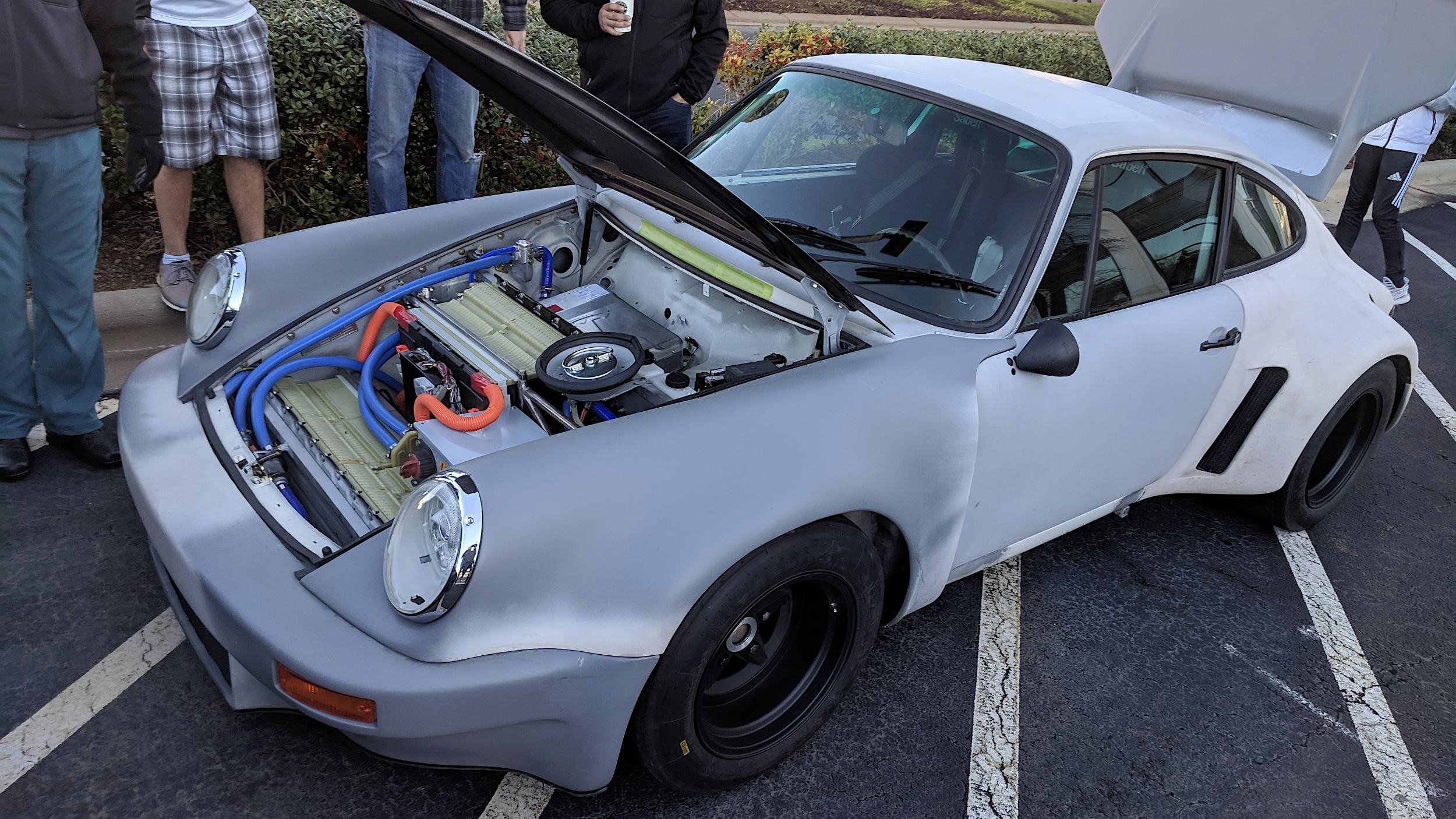
Tesla drivetrain, no paint, and a crowd. The owner drove it here. Recommended.
If it does not run, it goes to the front of the line. Anything that makes the car undrivable gets finished before anything that makes it nicer. This sounds obvious in writing. It is not obvious at nine on a Wednesday night when the fun part is right there.
What actually happened
I listed the Beetle before it was done. The metal was in and largely finished. The car was, by any fair reading, getting genuinely nice. It had also never once driven for me.
I felt like a quitter for about two weeks leading up to it. I felt relieved within an hour of it leaving, and I have not thought about it with regret since.
The money went into air suspension and wheels for my Volkswagen CC. That car was already registered, already insured, already running. The parts went on over a couple of weekends. I drove it that season and I showed it that season, which is two more things than the Beetle ever did in six years.
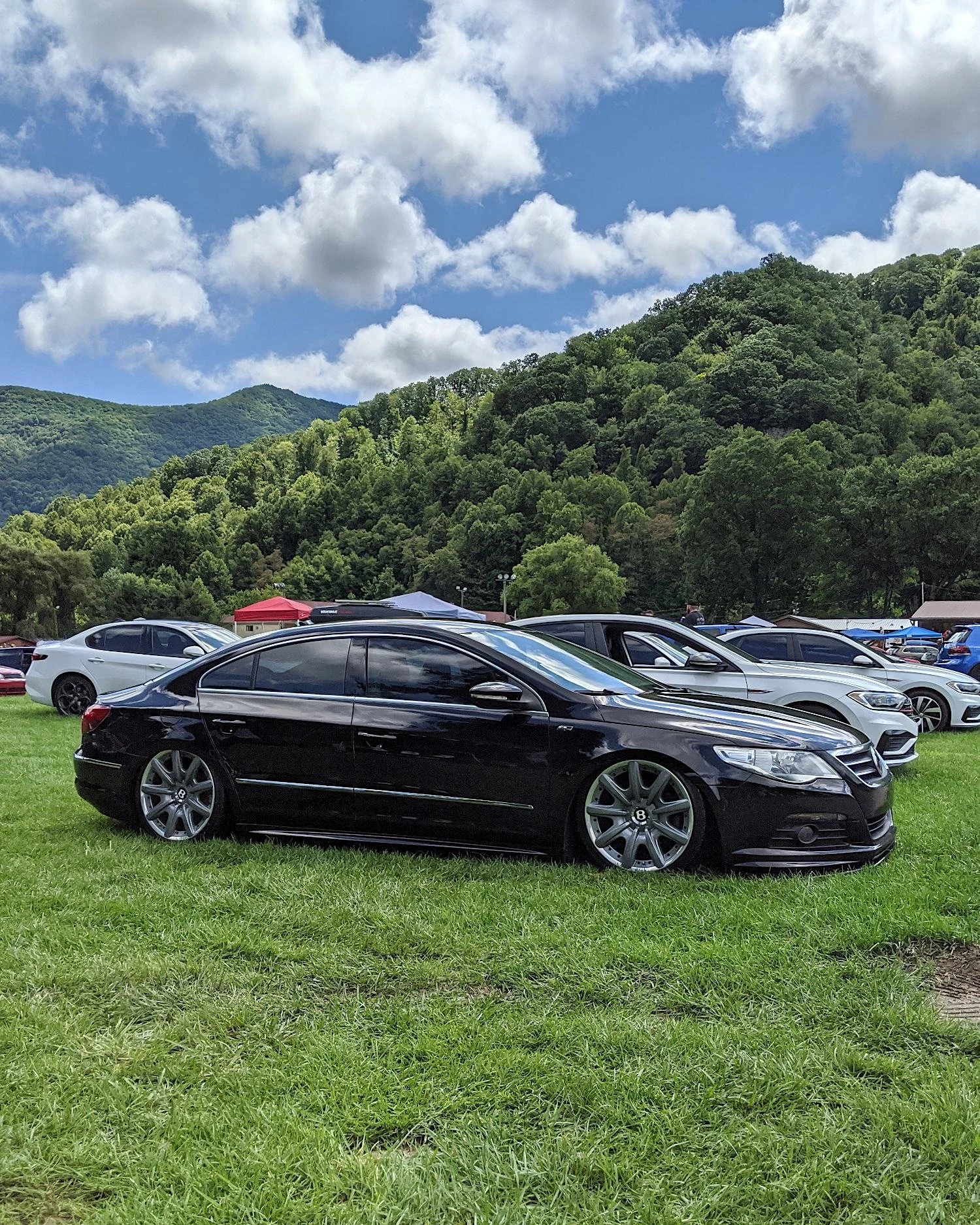
Air suspension and wheels, bought with the Beetle money and installed over two weekends. The car was already registered and insured.
That is the trade. A car I had a lot of myself in, for a car I could actually use. It is not a sad story. I had it backwards for years and then I fixed it.
Your next step takes about ten minutes. Go out to the garage tonight and answer one question in writing (I used a yellow legal pad): what is the shortest list of jobs that gets this car legally on the road, and can I finish that list by the end of next month? Write the list. If it fits, cancel everything else on the car until the list is done. If it doesn't fit, or you can't write the list at all, take photos this weekend while the light is good and list it. Wanting to find out what your local car community looks like once you have something to drive is a much better problem, andit's an easier one to solve than most people think.
