You Don't Need a Club. You Need a Room With Chairs in it.
The car has been in the garage seven weeks. You drove it hard the first two. Then twice. Then once. Last Saturday you started it, let it warm up, backed it to the end of the driveway, washed it and put it away.
Nothing is wrong with it. That's the part that bothers you.
Driving alone to nowhere in particular stops being interesting faster than anyone warns you. People spend a year planning the purchase. Almost nobody plans the Saturday after.
The search that returns nothing useful
You type your make into a search bar and add "club near me." One of two things happens.
You get nothing. Or you get a single-make club whose nearest region meets ninety minutes away on a Tuesday, runs a concours in June and a banquet in November, and hides its calendar behind a membership wall.
Neither of those is the club's fault. The problem is the search. You went looking for a group organized around your car.
Two things actually determine whether a gathering turns into your people. Does it repeat on a schedule you can predict, and does it give anyone a reason to stay once they've walked the lot.
Cars and coffee scores well on the first and badly on the second. Think about the physical setup. You're standing on asphalt at 8 a.m. in November. There are no seats. It's loud when cars leave. You have no shared task and no reason to still be there at 9:30. The format has an exit ramp built into it. That's why you can attend the same meet eleven times and know four faces and zero names.
Before anything else, decide how many minutes you will actually drive at 7:30 on a Saturday. Be honest, because you'll hold yourself to it. With kids at home it's usually 45. Outside a metro it's 60 to 75 and that's normal. Everything inside that circle is your scene now, whether or not it looks anything like your car.
The gathering with a second reason
This is where most people should start, and it's the category nobody writes about.
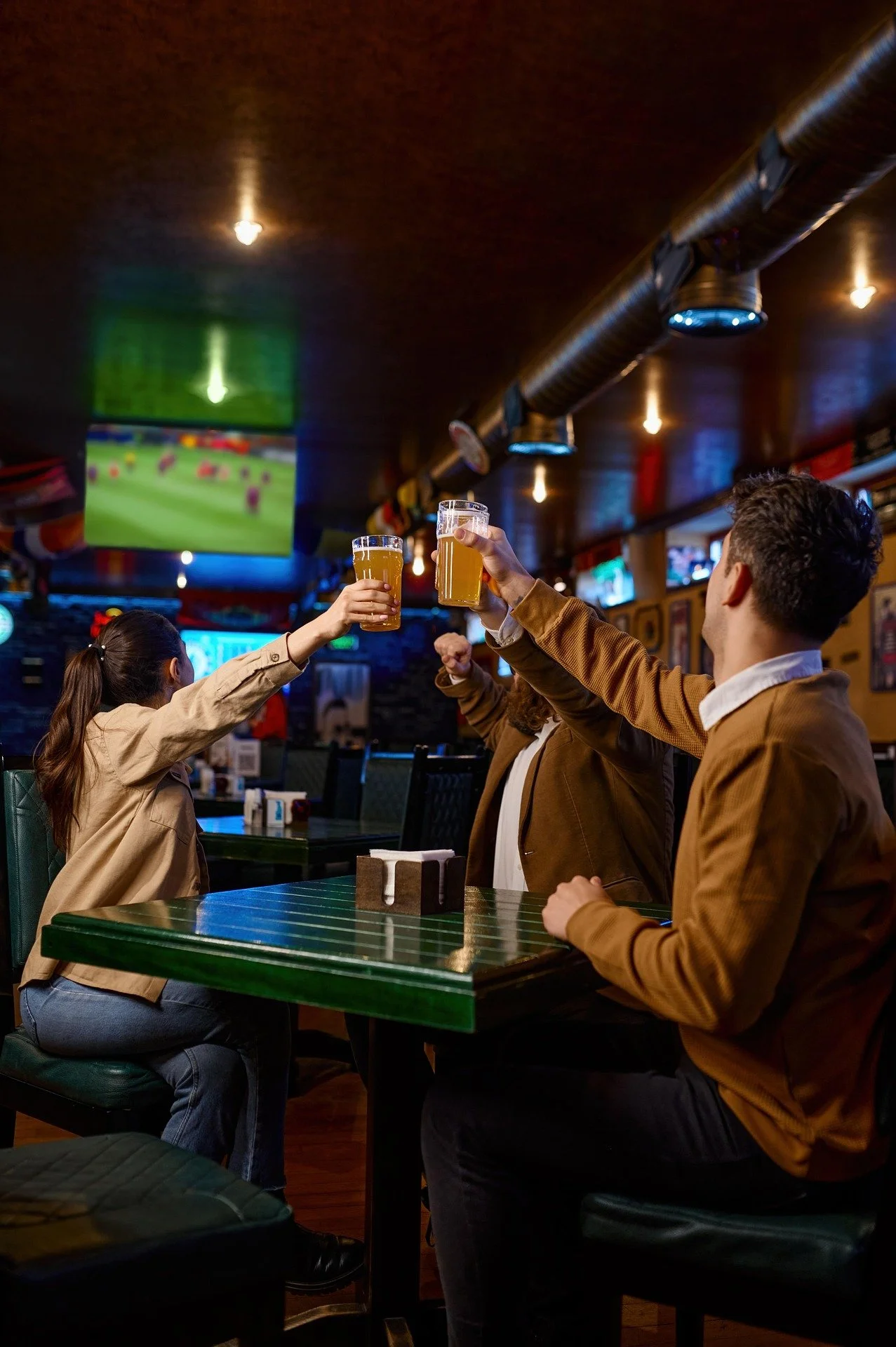
Porsches and pints. A distillery run that ends with a tour. A brewery on a Sunday afternoon for the F1 Americas rounds, somebody's shop at nine in the morning for the European ones. A karting league every other Thursday. A group that splits the 24 Hours of Le Mans into shifts.
None of those is a car club. The car is the filter that gets you in the room. Something else is the agenda that keeps you there for two hours.
For anyone in their late thirties with a job and a kid, these beat the parking lot on nearly every measure. They're weatherproof. Many run in the evening, so they don't consume a Saturday morning you were going to lose anyway. Fine for a spouse who is politely uninterested in cars, because a brewery is a brewery.
And the big one. You can show up without the car. When your project is on jackstands for six weeks, you show up to meets in a minivan and have to look for another lot to park in. The bar does not check what you drove.
The F1 option is worth understanding specifically. US audiences went from 554,000 viewers per race in 2018 to 1.3 million in 2025, a 135 percent increase over eight seasons. Then for 2026 the US rights moved to Apple TV exclusively. That paywall is the entire reason the brewery version is growing. Plenty of people who want to watch don't have the subscription, and the place with the projector does. If a bar within your radius shows races on Sunday morning, there is already a group in there, and it is almost certainly not advertised anywhere you've looked.
The trail
Overlanding gets its own heading because it doesn't work like anything else here.
Everything else in this piece is organized around a car. Overlanding is organized around a destination, and the vehicle is equipment. That changes three things at once.
It inverts the geography. Every other format on this list thins out as you leave a metro. This one improves. If you live an hour from public land, a national forest road, or anything with a Backcountry Discovery Route running through it, you have more of this available than someone in Chicago does.
You're probably already qualified. The entry vehicle is a 4Runner, a Tacoma, a Bronco, a Gladiator, an older Grand Cherokee. For a lot of people reading this, that's the daily sitting in the driveway. Airing down and a recovery strap will get you on most easy trails.
And the one nobody says out loud: you can bring the kids. Few other things in the hobby can make that claim. A trail day can be a family day. A campout is a family weekend. If your spouse has started doing arithmetic on how many Saturdays the car costs, this is the option that ends the argument instead of feeding it.
Overland Bound runs a member map and a system called Rally Points, which are member-created meetups that range from a two-hour "Rigs and Coffee" to a multi-day route, organized by regional directors and local member reps. Past that, look for your state trail association, a Tread Lightly chapter, and the Facebook group named after the nearest national forest (For us this is Uwharrie).
The honest problem with overlanding is the slippery slope of gear. It is very easy to spend two years and eleven thousand dollars building a rig you have taken off pavement four times. Go on a trail run in a stock vehicle first. Buy nothing until you've done three.
The other four, briefly
The organized drive. Club tours, breakfast runs, charity drives, anything with a route sheet. Two to four hours of real road, a stop in the middle, food at the end. You will learn more about a person over 120 miles of two-lane than over six parking lots. If your radius contains exactly one thing, make it this.
The timed event. The SCCA puts most regional autocross entries between $25 and $45, plus a $10 to $20 weekend membership if you're not a member. Track Night in America runs around $170 an evening across roughly 30 tracks and about 140 dates a season. Street tires, a borrowed helmet, a five-minute tech inspection. Nothing converts strangers faster than shared difficulty. You will be slower than you expect, someone will walk over unprompted and tell you what you're doing with the wheel, and you'll remember that person for years.
The work-adjacent thing. Tech sessions, shop days, swap meets, the Saturday somebody needs a gearbox out. Lowest glamour and highest conversion rate in the hobby. Nobody who has held a transmission jack for you stays a stranger.
Some of the most memorable days I have were with my brother or friends working on one of their cars for an entire Saturday. Putting some music on and getting in the zone. Elite weekend.
The judged show. Everyone is stationed at their own car, everyone is being evaluated. Go to look at the cars. That's the real reason. Don't expect to meet your people here. Better to meet them elsewhere then go to shows together.
Metro problem, small-town problem
In a big metro there’s no shortage of options. Probably fifteen or more options inside thirty minutes, so you try a different one every weekend, and after three months, you're a stranger at all of them. Variety feels like progress and isn't. Pick two, one social and one that involves driving, and go to those and nothing else for a full season.
Outside a metro, the scene exists and it does not have a website. It's in a Facebook group named after the county. It's on an index card at the parts counter. It's at the Sonic on the third Friday, April to October. It skews fifteen years older than you and the median car has a small block in it. Go twice anyway. The gap between a 1969 Chevelle and a 2003 Miata closes fast when both owners have replaced their own fuel pump.
One thing worth knowing out there. The AACA has more than 400 regions and chapters across all 50 states, the densest local club network in rural America by a wide margin. Almost everyone our age writes it off as a Model A organization. The eligibility line is 25 years, which in 2026 means 2001 and older. Your E46, your NB Miata, your Mk1 TT. They also run a Driver Participation Class built specifically for older unrestored cars that get driven, which is closer to the point of this publication than the name on the door suggests.
Where to actually look
Forty minutes of work, in this order.
MotorsportReg. The registration backbone for most organized driving in North America: over 1,000 clubs, tracks and sanctioning bodies, more than 10,000 events a year. Filter by distance from your ZIP and read the whole list, including things you assume you're not qualified for. Start with the calendar.
Facebook, searched deliberately wrong. Don't search your make. Search the county. Search the regional nickname people actually use. Search "cars and coffee" plus the nearest town of any size. The groups that matter have 800 members, a cover photo from 2019, and a post every Thursday.
The independent shop counter. Whoever works on European or JDM or muscle inside your radius knows every group within an hour and will tell you in ninety seconds. Highest-yield question on the list and it costs nothing.
Your bar or brewery. Ask whoever runs the taproom whether anyone comes in for the races. This sounds too simple to work. It works.
Region pages, read without joining. PCA runs roughly 145 regions across the US and Canada. BMW CCA has 68 chapters. Nearly all publish a public monthly calendar, and even for a car you don't own, you'll find the roads and shops they use.
The first three visits
Arrive early. Park where people are still pulling in, not buried in the middle where you're blocked until ten.
Bring a folding chair.
One question works every time. Where'd you find it? This gets a real answer instead of a recitation of factory specs.
Leave with one phone number. Not five. One.
Then come back the next month and the month after. Somewhere around the third appearance you stop being a visitor and people start leaving a space next to them.
Starting your own
If your radius genuinely contains nothing, the bar is lower than you think, and it's lowest for the informal formats.
A parking lot meet needs a lot with twenty spaces and an owner who doesn't mind. A watch party needs a bar with a TV that isn't busy at 9 a.m. on a Sunday, which describes every bar. Ask the owner. They will say yes, because you are proposing to fill a dead room.
Then pick a date stated as a rule rather than a plan. First Saturday, 8:00. Post it in the county group, tell your shop, print ten index cards for the parts store. Run it six straight months including the mornings when four people come and two of them are your neighbor. Meets don't fail from low turnout. They fail because the organizer moved the date twice and everyone stopped trusting it.
The real cost
It isn't money. Autocross is $45. A tank of gas and a biscuit is $60. A pint and a race is $8.
The cost is one recurring block, claimed in advance and defended against everything else that wants it. Put it in the family shared calendar with the actual name of the thing, not "car stuff." Then treat it the way you treat a dentist appointment. Something you occasionally move and never delete.
The car doesn't need a club. You need somewhere to be at nine on a Sunday morning, and it turns out the car was only ever the excuse.
